Percent Error Calculator
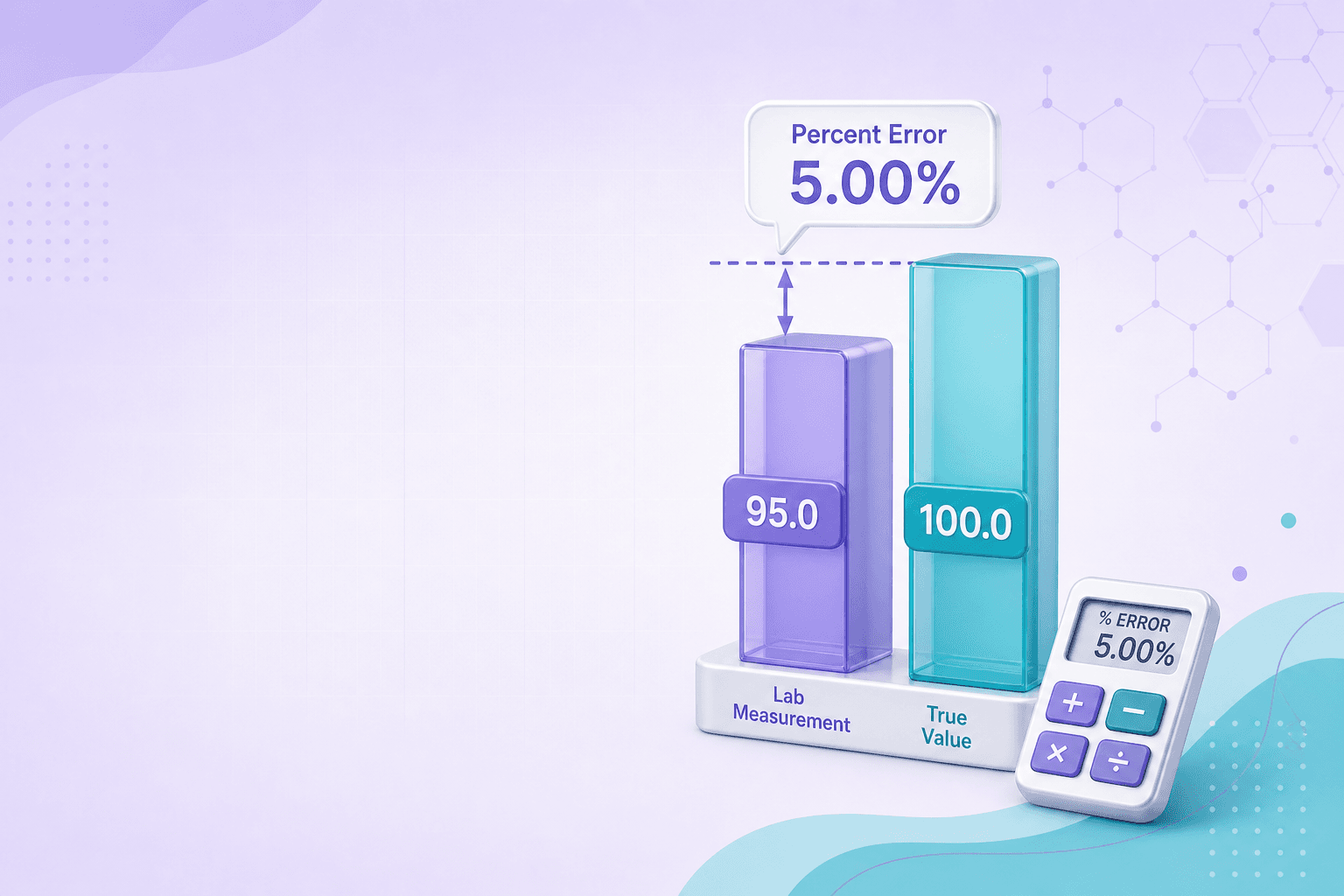
Compute percent error from experimental and theoretical (accepted) values. Uses |experimental − theoretical| ÷ |theoretical| × 100%.
FAQ for this calculator
- Can theoretical be negative?
- Yes—the formula uses absolute value of theoretical in the denominator.
- Is this the same as percent difference?
- No—percent error specifically compares measurement to an accepted reference.
- Why absolute error?
- It shows the raw gap between values before scaling to a percentage.
- What if theoretical is zero?
- Percent error is undefined—use absolute error or another metric instead.
How to use the percent error calculator
Percent error compares a measured result to an accepted value as a percentage of the accepted magnitude.
- Enter the experimental (measured) value.
- Enter the theoretical or accepted value.
- Read percent error and absolute error in the results panel.
When to use this calculator
- Chemistry lab reports comparing measured density to handbook values.
- Physics homework checking sensor readings against predicted outcomes.
- Quality control when spec targets are non-zero reference values.
Examples & walkthrough
- Experimental 9.8, theoretical 10 → 2% percent error.
- Experimental 50, theoretical 48 → about 4.17% percent error.